
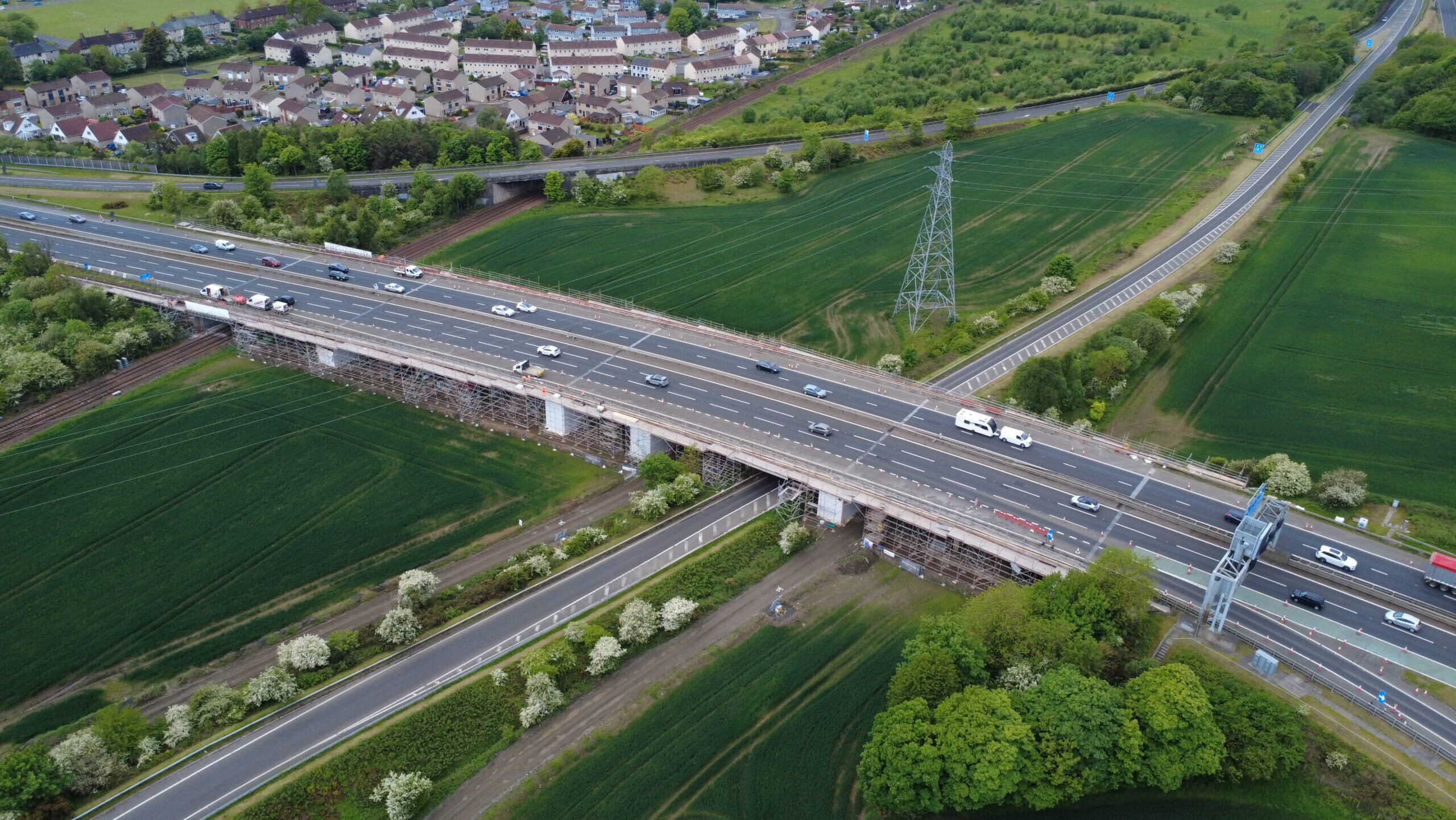
Between July and September 2026, BEAR Scotland delivered a significant programme of maintenance, improvement and renewal works across the South East trunk road network, investing more than £26 million on behalf of Transport Scotland in roads, bridges, safety improvements and routine maintenance, while continuing to keep traffic moving and supporting local communities.
The quarter saw substantial progress on some of Scotland’s most important transport assets, including the Forth Road Bridge, Queensferry Crossing, Kincardine Bridge and the wider trunk road network. Major bridge maintenance teams continued extensive refurbishment and preservation works on the Forth Road Bridge, including hanger painting, strengthening works, grillage refurbishment and preparations for the replacement of critical lateral thrust bearings. By September, hanger painting works for the season had been completed.
At the M90 Masterton Viaduct, refurbishment works were completed, with cathodic protection systems installed, concrete repairs completed and parapet upgrades finished, allowing the removal of long-term traffic management in August.
September also marked the start of a major deck refurbishment project on Kincardine Bridge, involving carriageway and footway reconstruction, waterproofing, concrete repairs and vehicle restraint system upgrades designed to improve the bridge’s long-term resilience.
Across the quarter, BEAR Scotland completed 23 structural maintenance schemes on key routes including the A1, A7, A68, A702, A720, M8, M9, M90 and M876. The programme delivered renewed road surfaces, improved ride quality and enhanced resilience across the network.
Highlights included:
A particularly notable achievement was the completion of an eight-week ex-situ recycling programme on the M8 and A702. Approximately 5,400 tonnes of recycled material were reused within carriageway reconstruction works, preventing material from being sent to landfill and saving up to 270 tonnes of CO₂ emissions.
Strategic Road Safety schemes continued to deliver targeted improvements aimed at reducing risk and improving driver behaviour.
During the quarter, BEAR Scotland completed motorcycle safety improvements at A7 Galalaw Roundabout, vehicle restraint system upgrades on the M8 and M9, and implemented a trial layout at A702 Lothianburn Junction to reduce late lane changes and improve traffic flow. Additional work progressed on A7 Langholm, A68 Camptown and several key junctions across the network.
Road marking and road stud renewal programmes continued on the M9, M80 and M90, with over £1.9 million invested by the end of September in improving lane delineation and visibility for road users.
Climate resilience remained a key focus throughout the summer.
Drainage improvement projects advanced on the A1, M9 and M90, while a number of adaptation schemes investigated and addressed flooding hotspots across the network. Construction commenced on a major drainage improvement scheme between Houndwood and Burnmouth on the A1, while large-diameter drainage pipe replacement works near the M9 continued to reduce flood risk affecting both the network and neighbouring land.
Work also progressed on the M90 between Junction 1A and Junction 2, combining drainage improvements with filter-stone recycling to enhance the performance and longevity of the route.
Jamie Finlayson, BEAR Scotland’s Contract Director for the South East Unit, said: “Our client Transport Scotland invested more than £48.7 million in the South East trunk road network during the 2026/27 financial year up to the end of September.
“The strong progress made between July and September demonstrates BEAR Scotland’s ongoing commitment to maintaining and improving Scotland’s strategic road network while delivering lasting benefits for road users, communities and the environment.”
 Winter Portal
 Planned Works
 Report a Defect